


Sustainable Agriculture in Africa: Balancing Productivity, Climate and Inclusion

Agriculture supports livelihoods, food systems and local businesses across Africa. Yet farmers face increasingly difficult choices: how to maintain production when rainfall is less predictable, soils are under pressure, and access to water, inputs and markets remains uneven. Sustainable agriculture in Africa is not a single technology or farming model. It is a way of improving production while protecting the natural resources and household incomes on which future harvests depend.
The Food and Agriculture Organization (FAO) describes climate-smart agriculture through connected goals: sustainably increasing productivity and incomes, strengthening resilience to climate change, and reducing emissions where feasible. What those goals mean in practice depends on local conditions. A drought-prone maize farm, a cocoa agroforest and a rice-growing area need different options, investment horizons and forms of support.
Practical choices start with local conditions
Healthy soil is one of a farm’s most important productive assets. Cover crops, crop rotation, intercropping, composting and agroforestry can help protect soil and retain moisture, although the right mix depends on the crop and landscape. Better water management, adapted planting dates and varieties, and integrated pest management can reduce exposure to seasonal shocks. Diversifying crops or income sources may also make a household less dependent on one harvest.
These sustainable agriculture practices involve trade-offs. A farmer may need seedlings, tools, labor practical training or technical advice before seeing any benefit. Trees may take years to contribute meaningfully to a cocoa plot; soil improvement can be gradual; a new crop may have no reliable buyer yet. Advice should therefore be rooted in local evidence and farmer experience, rather than treating a practice as universally beneficial. FAO’s smallholder work in Kenya and Tanzania highlights the value of participatory planning and assessing outcomes such as productivity, income and resilience together.
Why finance must fit the farm calendar
Agricultural finance can help farmers and producer groups purchase inputs, equipment, storage or services that are difficult to fund from cash on hand. But conventional lending terms may not align with a production cycle. A repayment date that falls before harvest sales can add pressure precisely when a household has little liquidity. Banks, microfinance institutions, insurance companies, cooperatives, buyers and public programs all have a role in developing finance that reflects cash-flow patterns, value chains and local risks.
Credit is only one part of the answer. Savings can provide a buffer, insurance can cover specified risks under clear terms, and digital payments can reduce the cost of reaching remote communities. Extension services, dependable buyers, storage and transport infrastructure also affect whether a farmer can make an investment pay off. Coordinating these services can make sustainable farming more feasible than offering a loan without complementary support.
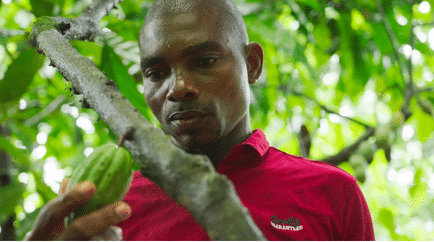

Being part of a cooperative allowed me to get fertilizer and benefit from training to learn new techniques, how to treat cocoa properly, and how to sell our products well. Today, my production has increased. I now produce more, which allows me to better feed my family.
Hervé
Cocoa farmer, Côte d’Ivoire
Financial Inclusion is part of productivity
Women farmers, young entrepreneurs and remote rural households may face barriers such as limited collateral, missing formal records or financial products designed for urban businesses. Rural financial inclusion means more than opening an account: it requires accessible information, suitable repayment schedules, transparent costs and services that reflect how rural enterprises earn and spend. Farmer organizations, including cooperatives and community groups such as village associations can connect members to finance, training and markets, provided that their governance and member protection are strong.
Cocoa in Côte d’Ivoire offers an example of finance supporting a longer-term transition. Through the Equité 2 program, represented by Agronomes et Vétérinaires Sans Frontières, Advans Côte d’Ivoire supported cooperative farmers investing in more resilient agroforestry systems. The initiative, links agricultural finance with technical and local partnerships rather than treating credit as a stand-alone solution.
Advans Côte d’Ivoire also offers agricultural loans for needs such as inputs, equipment and working capital. Across the continent, the challenge for Advans and other lenders is to combine appropriate finance with practical support and a clear understanding of the farm calendar. Sustainable agriculture in Africa can expand when farmers are able to invest in resilience while managing near-term cash needs—and when solutions are assessed over time with the people who use them.
Want to learn more about the opportunities and challenges facing farmers in Côte d’Ivoire? Discover Sondo’s story, an agricultural entrepreneur supported by Advans, in our Their Words, Their Story series.